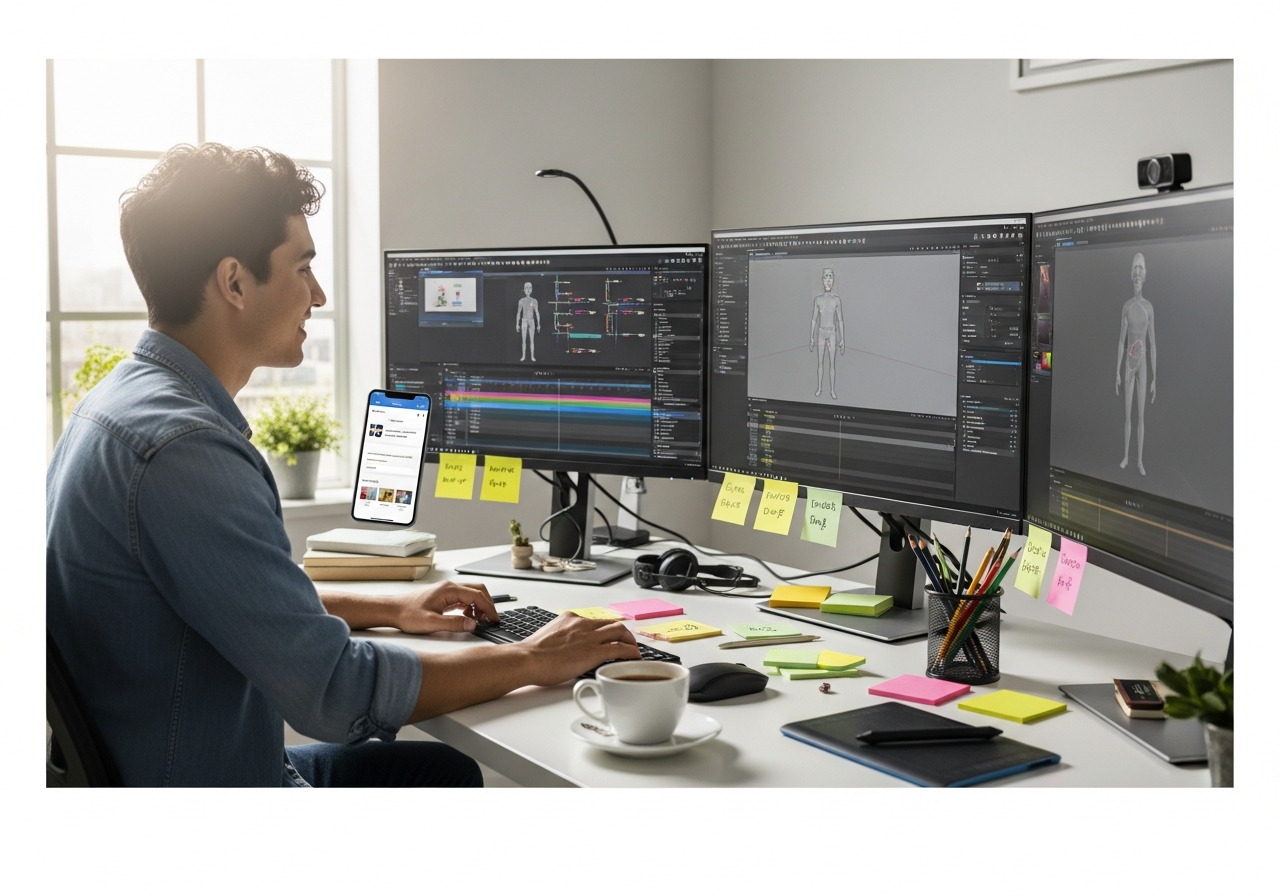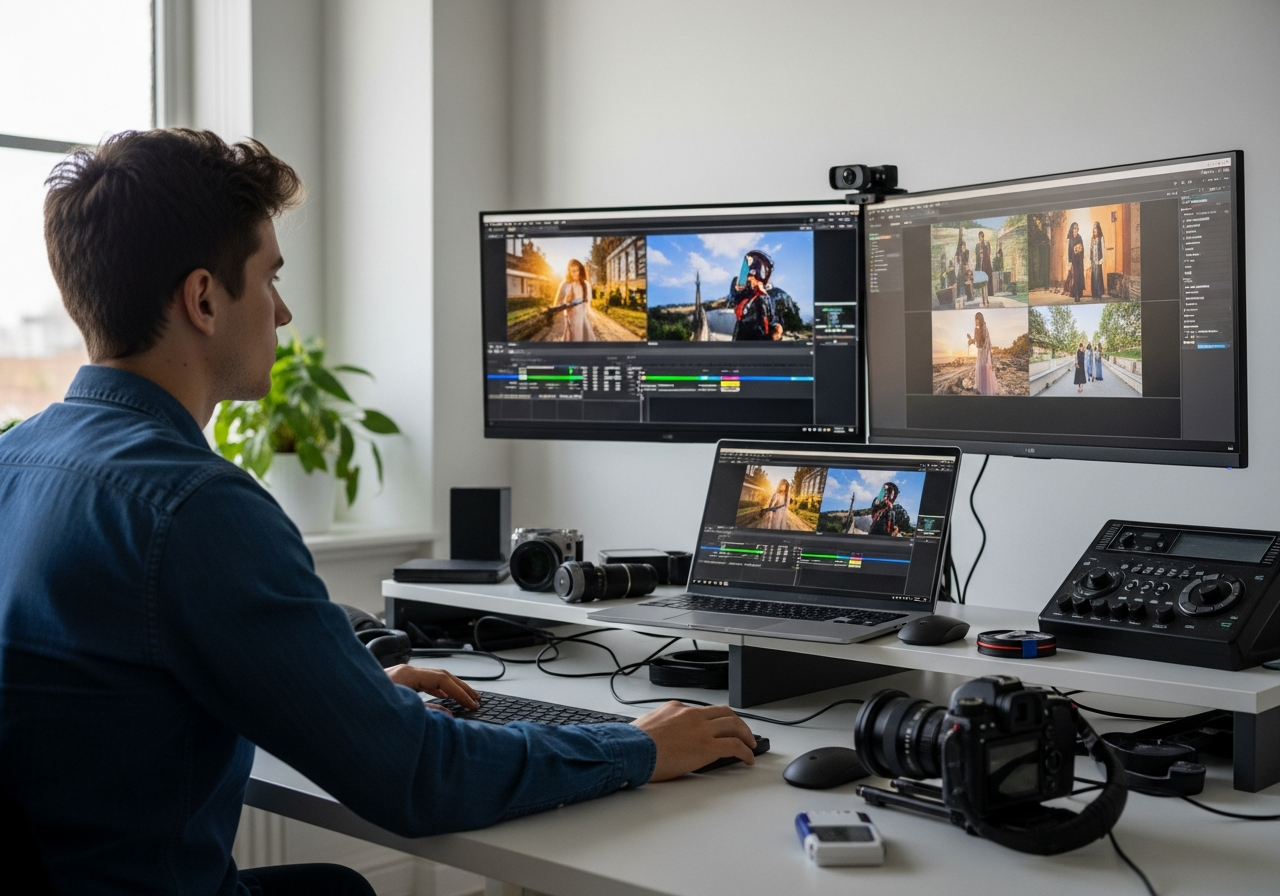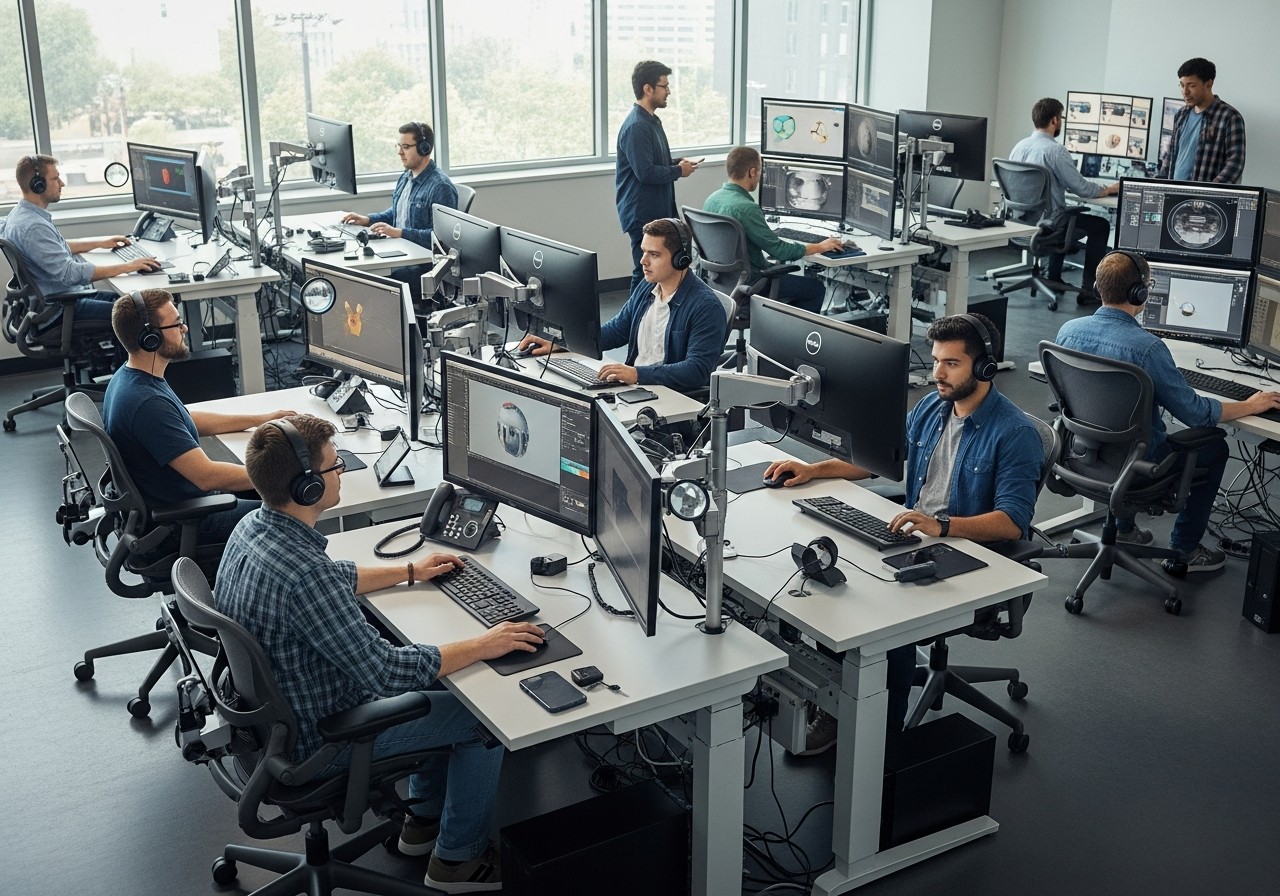

Canadian studios across gaming, VFX, animation, and experiential design rely heavily on portfolio reviews as their primary hiring filter for junior 3D environment artists. Unlike other industries where resumes and certifications dominate, creative studios place the portfolio at the center of their recruitment process, using it to assess not just technical skills but also artistic vision, problem-solving abilities, and cultural fit.
This article reveals what actually happens to your portfolio inside a Canadian studio—who examines it, the specific criteria they use, and how the review process unfolds from initial screening to final hiring decisions. We’ll explore unique Canadian considerations including Quebec’s language requirements, immigration constraints that affect eligibility, and emerging requirements like “no AI-generated art” clauses that appear increasingly in Canadian job postings. Based on analysis of current job advertisements, portfolio review practices at major studios, and feedback from industry professionals, this guide provides actionable insights beyond generic portfolio advice.
The Role of Portfolio Reviews in Canadian Junior Environment Art Hiring
A portfolio review in the context of Canadian studios is a structured evaluation process where multiple stakeholders examine a candidate’s creative work to determine their suitability for a junior 3D environment artist role. Unlike senior positions where shipped titles and industry experience carry significant weight, junior roles focus almost entirely on the portfolio’s demonstration of potential, artistic fundamentals, and technical competency. The portfolio essentially replaces traditional interview assessments, serving as both a skills test and a conversation starter.
Canadian studios spanning from major gaming companies like Ubisoft Montreal to boutique VFX houses in Vancouver have institutionalized portfolio-centric hiring. This approach reflects the creative industry’s need to see actual work rather than rely on academic credentials or internship descriptions. Studios use portfolios to gauge whether a candidate can contribute meaningfully to production pipelines, adapt to feedback, and grow within their artistic vision.
The portfolio sits at the top of the hiring funnel, often determining whether a candidate progresses to interviews or art tests. Canadian job postings increasingly emphasize that portfolios must contain original work, with explicit “no AI-generated art” requirements becoming standard. This shift reflects studios’ focus on authentic creative problem-solving and their desire to understand a candidate’s actual capabilities rather than their ability to curate AI outputs.
Why Portfolios Matter More Than Resumes for Junior Roles
Junior candidates typically present lightweight CVs featuring recent graduation dates, perhaps an internship, and coursework descriptions that tell hiring managers little about actual capabilities. In contrast, a well-constructed environment art portfolio immediately showcases modeling skills, lighting understanding, composition sense, and technical workflow knowledge. Studio leads consistently report that they can assess a candidate’s readiness for production work within minutes of viewing strong environment scenes.
Canadian studios structure their junior hiring processes around portfolio evaluation because they need to see evidence of core competencies: clean topology, proper UV mapping, effective texture work, and lighting that supports mood and narrative. These skills are difficult to convey through resume bullet points but become immediately apparent in portfolio presentations. Lead artists often mention that they can estimate a candidate’s learning curve and mentorship needs more accurately from portfolio work than from traditional interview responses.
How Canadian Studio Types Shape Portfolio Priorities
Gaming studios prioritize real-time rendering capabilities, looking for environments optimized for engines like Unreal or Unity, with attention to polygon counts, LOD systems, and performance considerations. VFX studios, conversely, focus on high-quality rendering, detailed texturing, and cinematic lighting that may not need real-time constraints. Montreal’s concentration of gaming studios means many portfolios lean toward real-time work, while Vancouver’s mix of film and game studios creates more diverse expectations.
Canadian studios working on experiential design projects—such as museum installations or themed entertainment—represent a unique portfolio niche. These studios look for environment artists who can create immersive spaces that consider physical visitor flow and interactive elements. Understanding your local studio landscape helps junior artists align their portfolio projects with the dominant industry focus in their target cities, whether that’s AAA gaming in Toronto, indie development in Montreal, or mixed-reality experiences in Vancouver.
Eligibility Filters Before Portfolio Review in Canadian Studios
Before any creative evaluation begins, Canadian studios apply several eligibility filters that determine whether a portfolio will receive serious consideration. These practical constraints often eliminate candidates regardless of portfolio quality, making it crucial for applicants to understand and address these requirements upfront.
The filtering process reflects both legal requirements around Canadian employment and practical studio needs around communication, location, and technical capabilities. Studios implement these filters to manage application volumes and ensure they invest review time in candidates who can realistically join their teams.
- Work authorization status – Canadian citizenship, permanent residency, or existing work permits that don’t require studio sponsorship
- Language requirements – English fluency for most positions, French language skills for Quebec-based studios, especially those receiving provincial funding
- Location and relocation willingness – Physical presence requirements for junior roles, willingness to relocate to studio cities like Montreal, Toronto, or Vancouver
- Core software proficiency – Demonstrated experience with studio-standard tools like Maya, Blender, Substance Painter, and relevant game engines
- Portfolio accessibility – Functional online portfolios with clear navigation, fast loading times, and professional presentation standards
- Original work verification – Compliance with “no AI-generated art” requirements, clear asset ownership, and proper crediting of any collaborative work
Canadian Work Permits, Quebec Rules, and Portfolio Access
Quebec studios operate under additional constraints due to provincial regulations around hiring. Studios receiving Quebec tax credits must demonstrate efforts to hire local talent first, and many positions require French language capability. International candidates often find their portfolios deprioritized not due to quality issues but because of the administrative complexity and time involved in work permit sponsorship for junior roles.
Global applicants frequently underestimate how work authorization affects portfolio review priority. Canadian studios typically review domestic candidates first, then permanent residents, and finally international applicants only if no suitable local talent emerges. This reality means international junior artists need exceptionally strong portfolios to justify sponsorship discussions, and they benefit from clearly stating their authorization status upfront rather than leaving studios to assume sponsorship requirements.
Who Reviews Junior Environment Portfolios Inside Canadian Studios
The portfolio review process involves multiple stakeholders within Canadian studios, each bringing different perspectives and evaluation criteria. Understanding who examines your work and what they prioritize helps candidates structure portfolios that speak effectively to each reviewer’s concerns and expertise level.
The typical flow moves from initial HR screening to detailed artistic evaluation by leads and directors. Each stage serves as both a filter and an information-gathering step, with reviewers building a comprehensive picture of the candidate’s suitability for both immediate contribution and long-term growth within the studio culture.
This multi-stage approach reflects the collaborative nature of environment art production, where junior artists must work effectively with diverse team members while receiving guidance from more experienced mentors. The review process essentially simulates this collaborative environment by exposing candidates to different types of feedback and evaluation styles.
| Role | Where in Pipeline They Review | What They Look For | Typical Decision Power |
|---|---|---|---|
| HR Recruiter | Initial screening | Portfolio navigation, style alignment, basic technical requirements | Gate-keeping, pass to artists or reject |
| Lead Environment Artist | Technical evaluation | Modeling quality, UV layout, texturing skills, workflow efficiency | Strong recommendation influence, mentorship assessment |
| Art Director | Creative assessment | Artistic vision, storytelling, mood creation, style adaptability | Creative direction fit, final artistic approval |
| Hiring Manager | Cultural fit review | Team integration potential, growth trajectory, project relevance | Final hiring decision, compensation determination |
| Senior Artists | Peer review | Collaboration potential, coachability indicators, technical depth | Advisory input, day-to-day working relationship assessment |
The Recruiter’s First Pass on Environment Art Portfolios
Recruiters typically spend 2-3 minutes on initial portfolio assessment, focusing primarily on presentation quality and obvious technical alignment rather than nuanced artistic evaluation. They assess whether the portfolio loads properly, displays clear navigation, and contains work that generally matches the studio’s visual style and technical requirements. This surface-level evaluation determines whether the portfolio advances to artistic team review.
Effective recruiters develop checklists based on input from their artistic teams, looking for specific software mentions, particular project types, and red flags like unclear asset ownership or overly sparse presentations. Their role involves protecting senior artists’ time by filtering out portfolios that clearly don’t meet baseline requirements, while ensuring promising candidates reach the appropriate evaluators.
How Leads and Art Directors Dig Into Junior Portfolios
Lead environment artists examine portfolios through the lens of production integration, asking whether the candidate demonstrates skills that translate directly to current project needs. They evaluate modeling topology for efficiency, examine UV layouts for texture optimization, and assess lighting setups for technical understanding. Leads particularly focus on workflow indicators—evidence that the artist understands asset creation from concept to final implementation.
Art directors approach portfolios from a creative leadership perspective, evaluating artistic vision, storytelling capability, and style adaptability. They look for evidence of mood creation, compositional understanding, and the ability to serve narrative goals through environmental design. Directors also assess coachability by examining portfolio iterations, looking for signs that the artist responds well to feedback and can evolve their approach based on direction.
Both leads and directors pay attention to process documentation, valuing candidates who can articulate their decision-making and problem-solving approaches. This documentation becomes particularly important for junior artists, as it demonstrates thoughtful practice and suggests readiness for collaborative feedback processes that define professional environment art production.
Core Evaluation Criteria for Junior 3D Environment Portfolios in Canada
Canadian studios evaluate junior environment art portfolios using a relatively consistent set of criteria, though the weighting of these factors varies between gaming, VFX, and experiential design contexts. Understanding this evaluation framework helps candidates prioritize their portfolio development efforts and address the most critical assessment areas.
The ranking of these criteria reflects both immediate production needs and long-term artist development potential. Studios seek candidates who demonstrate strong foundational skills while showing capacity for growth within their specific artistic and technical pipelines.
Recent trends in Canadian job postings emphasize certain technical proficiencies while maintaining focus on artistic fundamentals. The explicit mention of software tools like Maya, Substance Painter, and Unreal Engine in job requirements translates directly into portfolio evaluation priorities.
- Technical fundamentals – Clean modeling topology, efficient UV layouts, proper texel density, and understanding of real-time or rendering constraints
- Artistic composition and lighting – Effective mood creation, visual hierarchy, color theory application, and lighting that supports storytelling
- Software proficiency demonstration – Clear evidence of industry-standard tool usage, particularly Maya, Blender, Substance Painter, and relevant engine experience
- Portfolio presentation quality – Professional online presence, clear navigation, fast loading, and effective project documentation
- Style versatility – Ability to work across different visual styles, from realistic to stylized, demonstrating adaptability to various project requirements
- Original content verification – Compliance with “no AI-generated art” requirements, clear asset ownership, and authentic creative problem-solving evidence
- Process documentation – Breakdown images showing workflow stages, problem-solving approaches, and technical decision-making transparency
Balancing Artistic Fundamentals and Technical Tooling
Canadian studios consistently emphasize that strong artistic fundamentals matter more than specific software expertise, though technical proficiency provides the means to execute artistic vision effectively. The most successful junior portfolios demonstrate solid understanding of composition, color theory, and spatial design while showcasing competent use of industry-standard tools.
Studios prefer candidates who show end-to-end pipeline understanding—from initial blockouts through final optimization—rather than specialists in single software applications. This comprehensive approach suggests readiness for production environments where artists must adapt to different project phases and collaborate across multiple pipeline stages.
The balance between artistic and technical skills becomes particularly important for junior roles, where candidates need enough technical competency to implement feedback effectively while possessing the artistic foundation to grow into more creative responsibilities. Portfolios that demonstrate both areas convincingly position candidates as valuable long-term investments rather than immediate production resources.
How Canadian Studios Structure the Portfolio Review Workflow
Canadian studios have developed structured workflows for portfolio review that balance thorough evaluation with efficient use of senior staff time. These workflows typically progress through multiple stages, with each level adding depth and specificity to the assessment while filtering candidates based on increasingly refined criteria.
The workflow design reflects practical considerations around staff availability, decision-making authority, and the collaborative nature of creative hiring. Studios recognize that environment artists must integrate effectively with existing teams, making multi-perspective evaluation essential for successful hiring outcomes.
Understanding this workflow helps candidates prepare for different types of interactions and feedback, from initial automated screenings to detailed artistic discussions during live portfolio walkthroughs.
| Stage | Owner | Portfolio Focus | Common Outcomes for Junior Candidates |
|---|---|---|---|
| Initial Screening | HR/Recruitment | Eligibility, basic presentation, obvious fit assessment | Pass to artistic review or immediate rejection |
| Technical Review | Lead Artists | Modeling quality, workflow efficiency, technical competency | Detailed feedback notes, mentorship needs assessment |
| Creative Assessment | Art Director | Artistic vision, style fit, storytelling capability | Creative direction compatibility determination |
| Live Walkthrough | Multiple Team Members | Process explanation, problem-solving approach, collaboration style | Interview invitation or art test assignment |
| Final Decision | Hiring Manager | Overall fit, growth potential, team integration prospects | Job offer, rejection with feedback, or waitlist placement |
From Asynchronous Reviews to Live Portfolio Walkthroughs
Most Canadian studios transition promising candidates from asynchronous portfolio review to live walkthrough sessions, where candidates present their work directly to team members. These interactive sessions reveal critical thinking processes, communication skills, and the candidate’s ability to articulate design decisions under gentle pressure.
Live walkthroughs allow studios to assess aspects that static portfolios cannot demonstrate: how well candidates respond to questions, their depth of understanding regarding their own work, and their ability to engage in collaborative creative discussions. These sessions often determine final hiring decisions more than the initial portfolio content itself.
How Feedback Culture Influences Portfolio Decisions
Canadian studios with strong feedback cultures use portfolio reviews as windows into candidates’ potential receptiveness to mentorship and collaboration. Reviewers look for evidence that candidates actively seek and incorporate feedback, viewing portfolio iterations and documented improvements as positive indicators of coachability.
This cultural emphasis on feedback means that junior candidates benefit from demonstrating their response to critique through portfolio evolution over time. Studios value artists who can accept direction gracefully and translate feedback into meaningful improvements, seeing these traits as essential for successful integration into collaborative creative environments.
Environment Art Tests and Portfolio-Linked Assignments
Canadian studios frequently use art tests as extensions of portfolio evaluation, designing assignments that probe deeper into candidates’ capabilities while providing standardized comparison opportunities. These tests typically build upon portfolio observations, targeting areas where reviewers want additional evidence or clarification of skills and approaches.
Art tests in Canadian studios reflect local industry standards around fair assessment practices, typically providing clear time boundaries, reasonable scope, and compensation or consideration for the candidate’s effort investment. The relationship between portfolio content and test design helps ensure that assignments feel relevant and achievable rather than disconnected from demonstrated capabilities.
The testing process serves dual purposes: validating portfolio authenticity and providing fresh evidence of problem-solving approaches. Studios can observe how candidates handle new challenges while comparing their test results with portfolio presentations to assess consistency and growth potential.
- Portfolio gap analysis – Identify areas where additional evidence would strengthen candidate assessment
- Test scope definition – Design assignments that require 6-12 hours of focused work, matching industry fairness standards
- Clear instruction provision – Provide detailed briefs with constraints, expectations, and evaluation criteria transparency
- Submission format specification – Request breakdowns, process documentation, and final presentation materials
- Comparison with portfolio work – Evaluate consistency between test results and existing portfolio quality
- Feedback delivery – Provide meaningful responses regardless of hiring outcome, supporting candidate development
Using Portfolio Insights to Design Fair Art Tests
Canadian studios design art tests based on specific observations from portfolio reviews, creating assignments that feel like natural extensions of demonstrated capabilities rather than arbitrary hurdles. This approach ensures that tests provide meaningful assessment opportunities while respecting candidates’ time and effort investment.
Fair testing practices in Canada emphasize reasonable time constraints—typically one weekend’s worth of work—and clear evaluation criteria that align with actual job requirements. Studios that provide compensation for art tests or guarantee detailed feedback regardless of hiring outcomes demonstrate respect for candidate investment and contribute to positive industry reputation.
The most effective art tests reveal problem-solving approaches and creative thinking processes that static portfolios cannot demonstrate. By designing tests that build logically from portfolio observations, studios can assess growth potential and adaptability while maintaining fair and respectful candidate treatment standards.
Common Portfolio Mistakes Noted by Canadian Reviewers
Canadian studio reviewers consistently identify certain portfolio mistakes that undermine otherwise talented candidates’ hiring prospects. Understanding these common pitfalls helps junior environment artists avoid preventable rejection while focusing improvement efforts on issues that most significantly impact review outcomes.
These mistakes often reflect misunderstandings about professional standards, cultural expectations within Canadian studios, or simple oversights in portfolio presentation. Many are easily correctable once identified, making awareness of common problems particularly valuable for candidate success.
Recent trends in portfolio mistakes include issues related to AI art policies and unclear asset ownership, reflecting evolving industry standards that candidates must navigate carefully to maintain credibility and legal compliance.
| Mistake | How It Appears in a Junior Portfolio | Impact on Canadian Studio Review | Fix or Alternative |
|---|---|---|---|
| Unclear Asset Ownership | Mixed personal and collaborative work without clear attribution | Immediate credibility concerns, legal risk assessment | Detailed breakdowns showing individual contributions |
| Poor Presentation Structure | Confusing navigation, slow loading, inconsistent formatting | Reviewer frustration, reduced time investment | Clean, fast-loading portfolio with intuitive organization |
| Repetitive Asset Creation | Multiple projects using similar approaches or subjects | Questions about creative range and problem-solving variety | Diverse projects demonstrating different skills and styles |
| Missing Process Documentation | Final images only, no workflow or breakdown information | Inability to assess technical understanding or teachability | Step-by-step breakdowns showing technical decisions |
| Outdated Software Skills | Focus on deprecated tools or outdated workflow approaches | Concerns about learning curve and adaptation time | Current industry-standard tool demonstrations |
| Weak Fundamental Skills | Poor composition, lighting, or modeling topology | Questions about readiness for professional production | Focused skill development in identified weak areas |
Red Flags That Quickly End a Junior Portfolio Review
Certain portfolio issues cause immediate rejection regardless of other strengths, particularly unclear asset ownership and fundamental skill deficiencies that suggest extensive mentorship requirements. Canadian studios working under tight production schedules cannot invest months in basic skill development, making strong foundational competencies essential for junior role consideration.
Other fast-rejection triggers include ignoring local studio expectations—such as submitting film-rendering focused work to real-time gaming studios—and presentation problems that suggest unprofessional attitudes toward communication and organization. These issues signal potential cultural fit problems beyond artistic capabilities.
Presentation Pitfalls: Navigation, Thumbnails, and Captions
Portfolio organization problems frustrate reviewers and reduce the time they invest in evaluation, particularly when navigation feels confusing or images load slowly. Canadian reviewers often mention abandoning portfolio reviews due to technical presentation issues rather than artistic content problems.
Effective portfolio presentation requires clear thumbnail images, descriptive captions explaining creative decisions, and logical organization that guides reviewers through projects efficiently. These seemingly minor details significantly impact reviewer experience and willingness to engage deeply with the creative content.
Designing a Portfolio That Aligns With Canadian Studio Expectations
Creating a portfolio that resonates with Canadian studio reviewers requires understanding both universal professional standards and specific local market characteristics. Successful portfolios demonstrate technical competency while showcasing adaptability to Canadian industry focuses, from real-time gaming optimization to narrative-driven VFX work.
Canadian studios value portfolios that show cultural awareness and market understanding, particularly when candidates demonstrate knowledge of local studio specialties or incorporate themes that resonate with Canadian audiences and industry focuses.
The most successful portfolio strategies combine strong foundational skills with evidence of growth potential and collaborative readiness. Studios seek candidates who can contribute immediately while developing into more senior creative roles over time.
- Prioritize technical fundamentals – Demonstrate clean modeling, efficient UV layouts, and proper workflow understanding before pursuing stylistic sophistication
- Show workflow transparency – Include breakdown images, process documentation, and technical decision explanations that reveal problem-solving approaches
- Target local studio focuses – Align project types and technical approaches with your target city’s dominant studio specialties
- Demonstrate style adaptability – Include projects spanning realistic to stylized approaches, showing flexibility for diverse client requirements
- Ensure professional presentation – Create fast-loading, clearly organized online portfolios with intuitive navigation and comprehensive project descriptions
- Document collaborative experiences – Clearly credit team contributions while highlighting your specific roles and responsibilities in group projects
- Emphasize original creative work – Comply with “no AI-generated art” requirements while showcasing authentic problem-solving and creative decision-making
Tailoring Portfolio Projects to Canadian Market Niches
Canadian studios appreciate portfolios that reflect understanding of local industry strengths and cultural contexts. Projects incorporating recognizable Canadian landscapes, architectural styles, or cultural references demonstrate market awareness while showcasing technical skills within familiar contexts.
Beyond cultural content, successful portfolio tailoring involves understanding technical requirements specific to Canadian studio focuses. Gaming-heavy markets like Montreal benefit from real-time optimization demonstrations, while VFX-focused areas like Vancouver value high-quality rendering and cinematic lighting approaches.
The most effective market-tailored portfolios balance local relevance with universal appeal, ensuring that projects serve multiple audiences while demonstrating specific understanding of target studio requirements and cultural contexts.
How Portfolio Reviews Feed Into Onboarding and Growth in Canadian Studios
The portfolio review process provides Canadian studios with detailed insights that extend far beyond initial hiring decisions, informing onboarding strategies, mentorship assignments, and early career development planning. Studios use portfolio observations to design personalized growth trajectories that build upon demonstrated strengths while addressing identified development areas.
Understanding this connection between portfolio content and post-hire development helps candidates present work strategically, emphasizing not just current capabilities but also learning readiness and growth potential. Studios value portfolios that suggest successful long-term investment rather than immediate peak performance.
The feedback gathered during portfolio reviews becomes foundation material for ongoing mentorship relationships, helping senior artists understand new hires’ backgrounds, preferences, and development needs from their first day forward.
| Portfolio Signal | How It Influences Onboarding | Mentorship Focus | Early Performance Metrics |
|---|---|---|---|
| Strong Technical Skills | Faster integration into production tasks | Creative development and artistic growth | Asset delivery speed and quality consistency |
| Creative Problem-Solving | Assignment to conceptual and design tasks | Technical skill refinement and optimization | Innovation in approach and solution quality |
| Process Documentation | Responsibility for knowledge sharing and training | Leadership development and communication skills | Contribution to team efficiency and workflow improvement |
| Style Versatility | Cross-project assignment flexibility | Specialization development in preferred areas | Adaptability scores and client satisfaction ratings |
| Collaborative Indicators | Team integration prioritization and social connections | Advanced collaboration and feedback reception | Peer feedback quality and team contribution measures |
Turning Portfolio Feedback Into a Professional Development Roadmap
Canadian studios increasingly provide detailed feedback from portfolio reviews regardless of hiring outcomes, recognizing this practice’s value for industry development and future recruitment opportunities. Candidates who actively incorporate this feedback into portfolio improvements demonstrate growth mindset and professional maturity that studios value highly.
The most successful junior artists treat portfolio feedback as foundation material for ongoing skill development, creating improvement plans that address identified weaknesses while building upon recognized strengths. This approach transforms rejection feedback into valuable professional development guidance that improves future application success.
Studios often track candidates who respond well to feedback, creating opportunities for future consideration as skills develop and positions become available. This long-term relationship approach benefits both studios and artists by maintaining connections with promising talent while supporting industry-wide skill development initiatives.